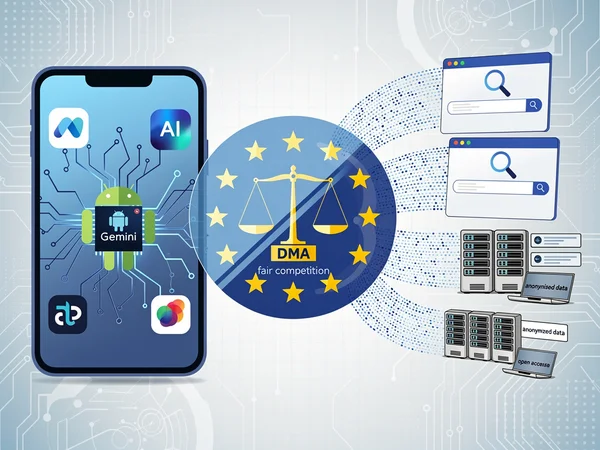
BRUSSELS—Google faces a pivotal regulatory challenge from European Union authorities, who on January 26, 2026, launched two specification proceedings under the Digital Markets Act to enforce compliance on Android interoperability and search data sharing. The moves target barriers blocking rival AI services from matching Google’s Gemini on the world’s dominant mobile operating system and aim to unlock anonymized search metrics for competitors.
EU Executive Vice-President for Tech Sovereignty, Security and Democracy Henna Virkkunen announced the proceedings in a post on X, stating, “We have started two sets of proceedings to assist Alphabet in complying with its obligations on AI services interoperability and online search data sharing under the DMA. This will ensure more open and innovative AI and Search services to the benefit of consumers and businesses.” X post by Henna Virkkunen
The first proceeding, under Article 6(7) of the DMA, demands Google provide third-party AI developers with “free and effective interoperability” to Android hardware and software features used by Gemini, such as those enabling seamless device integration. The second, under Article 6(11), requires fair, reasonable, and non-discriminatory access to anonymized Google Search data—including ranking, query, click, and view metrics—for rival search engines and potentially AI chatbots. Proceedings must conclude within six months, with preliminary findings due in three months for Google’s response and public comment. European Commission press release
Advertisement
article-ad-01Android’s Gatekeeper Role Under Fire
Google’s Android powers over 70% of global smartphones, making it a designated gatekeeper since September 2023, obligated to full DMA compliance by March 2024. Regulators argue current setups favor Google’s ecosystem, tilting competition toward its services. “Artificial Intelligence tools are transforming the way we seek and receive online information on our smartphones,” the Commission stated, emphasizing the need for an even playing field. European Commission press release
Bloomberg reported the EU handed Google a “six-month European Union deadline to lift technical barriers to rival AI search assistants on Android and give key data to other search engine providers.” This echoes prior DMA actions, like guidance to Apple two years ago on ecosystem openness. Google Senior Competition Counsel Clare Kelly responded, “Android is open by design, and we’re already licensing Search data to competitors under the DMA. However, we are concerned that further rules… will compromise user privacy, security, and innovation.” Bloomberg Channel News Asia
EU antitrust chief Teresa Ribera added, “We want to maximise the potential and the benefits of this profound technological shift by making sure the playing field is open and fair, not tilted in favour of the largest few.” Virkkunen elaborated, “Today’s proceedings… will provide guidance to Google to ensure that third-party online search engines and AI providers enjoy the same access to search data and Android operating system as Google’s own services, like Google Search or Gemini.” Channel News Asia
Data Access: Fuel for AI Challengers
Search data sharing focuses on defining data scope, anonymization methods, access conditions, and eligibility for AI providers. Rivals like Perplexity or OpenAI’s potential search tools could use this to train models and refine offerings, countering Google’s data moat. The Commission noted, “Millions of Europeans rely daily on online search engines, and increasingly on AI services.” Non-compliance risks fines up to 10% of global revenue or periodic penalties, though these proceedings prioritize guidance. European Commission press release
Industry watchers on X highlighted the stakes, with Techmeme posting, “The EU gives Google a six-month deadline to lift technical barriers to rival AI search assistants on Android and give key data to other search engine providers.” Digital EU echoed, “Commission opens two proceedings… Interoperability with Android’s operating system for third-party AI services and fair access to Google Search data must be ensured.” Techmeme on X Digital EU on X
This builds on Google’s antitrust history, including a €4.3 billion Android fine in 2018 (under appeal) and recent probes into AI Overviews using publisher content without fair pay, as reported in December 2025 by TechCrunch and Reuters. Those investigations examine if Google imposes unfair terms on websites while denying rivals YouTube data for training. TechCrunch
Google’s Defense and Broader Ramifications
Google insists Android’s openness fosters innovation, already sharing data under DMA. Yet rivals decry its dominance, with market share dipping below 90% in U.S. search amid ChatGPT’s rise, per reports. EU actions could reshape AI development, enabling startups to integrate deeply with Android devices—think voice assistants rivaling Gemini or search apps leveraging Google’s query logs. Channel News Asia
Compliance might require Android engineering overhauls, like exposing APIs for on-device AI processing or secure data pipelines. Preliminary findings in three months could detail fixes, with public input shaping final measures. Bloomberg noted this as part of the EU’s “Big Tech crackdown,” pressuring re-engineering for rival access. Failure invites escalation, mirroring Apple’s DMA battles. Bloomberg
For consumers, outcomes promise more AI choices on Android, potentially spurring innovation in personalized search and assistants. Businesses gain from competitive data flows, but Google warns of privacy risks. As proceedings unfold by July 2026, Alphabet’s response will test DMA’s teeth in the AI era.

LEAVE A REPLY
Your email address will not be published