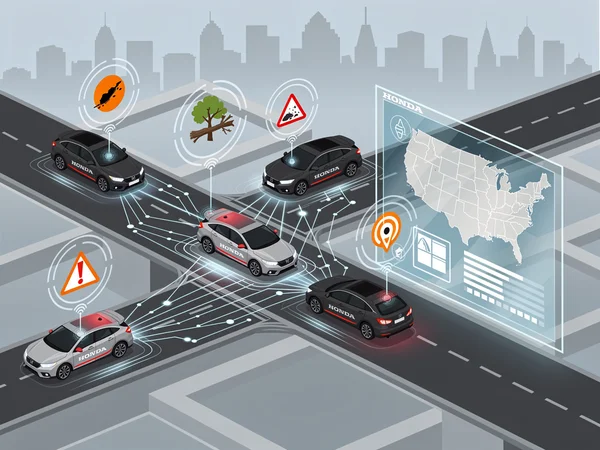
Honda Motor Company has launched an unprecedented initiative that turns everyday drivers into active participants in road safety monitoring, marking a significant evolution in how automotive manufacturers leverage connected vehicle technology. The Japanese automaker announced a groundbreaking pilot program that enables Honda vehicles to automatically detect and report road hazards, infrastructure problems, and safety concerns to municipal authorities—a first-of-its-kind collaboration between a private automaker and public safety agencies in the United States.
According to Engadget , the program represents a fundamental shift from reactive to proactive road safety management. Rather than waiting for citizens to file complaints or for regular inspection cycles to identify problems, Honda’s connected vehicles continuously monitor road conditions and automatically transmit data about potential hazards. The system identifies issues ranging from potholes and faded road markings to malfunctioning traffic signals and dangerous debris, creating a comprehensive, real-time picture of road conditions across participating municipalities.
Advertisement
article-ad-01The pilot program leverages Honda’s existing vehicle-to-everything (V2X) communication infrastructure, which has been quietly deployed across millions of Honda and Acura vehicles over recent years. These vehicles are equipped with sensors, cameras, and connectivity hardware that constantly collect data about driving conditions. What distinguishes this initiative is Honda’s decision to share this valuable data stream with government agencies rather than keeping it proprietary for internal use or limiting it to driver-assistance features.
From Private Data to Public Good: The Technical Architecture
The technical foundation of Honda’s safety reporting system relies on sophisticated sensor fusion and machine learning algorithms that process vast amounts of vehicular data in real time. Each participating Honda vehicle functions as a mobile sensing platform, using existing hardware including forward-facing cameras, GPS systems, and accelerometers to detect anomalies in road conditions. When multiple vehicles report similar issues in the same location, the system’s confidence level increases, filtering out false positives while ensuring genuine problems receive prompt attention.
The data transmission occurs through Honda’s proprietary telematics platform, which anonymizes vehicle and driver information before sharing it with municipal partners. This privacy-focused approach addresses concerns about surveillance and data security that have plagued other connected vehicle initiatives. The system transmits only relevant safety information—the type of hazard detected, its precise GPS coordinates, timestamp, and severity assessment—without identifying individual drivers or tracking vehicle movements beyond what’s necessary for hazard verification.
Municipal Partnerships and Implementation Challenges
The initial pilot program has partnered with select municipalities that possess the technical infrastructure and administrative capacity to receive, process, and act upon the automated hazard reports. These early adopters are integrating Honda’s data feeds into existing work order management systems, allowing road maintenance crews to prioritize repairs based on real-time information rather than scheduled inspections or citizen complaints alone.
City officials involved in the program have reported significant improvements in response times for road hazard mitigation. Traditional systems rely heavily on citizens noticing problems, taking time to file reports through municipal apps or hotlines, and then waiting for verification before repairs are scheduled. Honda’s automated system eliminates the first two steps entirely, potentially reducing the time between hazard emergence and repair by days or even weeks. This acceleration matters particularly for safety-critical issues like potholes that can cause vehicle damage or accidents, or faded lane markings that increase collision risks during adverse weather conditions.
However, the program faces implementation challenges that extend beyond technical considerations. Municipal governments must develop protocols for triaging the influx of automated reports, determining which issues require immediate attention versus routine maintenance scheduling. The sheer volume of data could overwhelm understaffed public works departments, particularly in smaller municipalities with limited resources. Additionally, liability questions emerge when governments receive automated notification of hazards but cannot immediately address them due to budget constraints or competing priorities.
Industry Implications and Competitive Dynamics
Honda’s move into proactive safety reporting positions the company distinctively within the automotive industry’s broader push toward connected and autonomous vehicle technologies. While competitors like General Motors, Ford, and Tesla have invested heavily in vehicle connectivity, their focus has primarily centered on enhancing driver experience, enabling over-the-air software updates, and developing autonomous driving capabilities. Honda’s decision to position its connected vehicle network as a public safety tool represents a different strategic calculus—one that emphasizes corporate citizenship and potential regulatory advantages.
The initiative could influence how regulators and legislators view connected vehicle mandates going forward. If Honda’s program demonstrates measurable improvements in road safety and infrastructure maintenance efficiency, policymakers might consider requiring similar capabilities from all automakers. This possibility creates both opportunity and risk for Honda: first-mover advantage in establishing industry standards and building government relationships, balanced against the potential commoditization of what is currently a differentiating feature.
Data Monetization and Business Model Questions
While Honda has positioned the pilot program as a public service initiative, questions naturally arise about long-term business models and data monetization strategies. The infrastructure required to collect, process, and transmit road hazard data represents significant ongoing costs. Honda must maintain servers, develop and update algorithms, ensure data security, and manage relationships with municipal partners—all activities that require sustained investment without obvious revenue streams.
Several potential business models could emerge as the program matures. Municipalities might eventually pay subscription fees for access to Honda’s road condition data, particularly if the program demonstrates clear cost savings through more efficient infrastructure maintenance. Insurance companies represent another potential customer, as real-time road hazard data could inform risk assessment models and potentially reduce claims related to road condition-caused accidents. Fleet operators might value access to hazard information for route planning and driver safety programs.
Alternatively, Honda might view the program primarily as a brand-building exercise and customer retention tool rather than a direct revenue generator. Drivers who appreciate their vehicles contributing to community safety might demonstrate stronger brand loyalty, while the positive publicity and government relationships could yield indirect benefits that justify the program’s costs. This approach aligns with Honda’s historical emphasis on corporate social responsibility and long-term relationship building over short-term profit maximization.
Privacy Considerations and Regulatory Compliance
The program’s success depends significantly on maintaining public trust regarding data privacy and usage. Honda has emphasized that the system transmits only anonymized hazard information without tracking individual driver behavior or vehicle locations beyond what’s necessary for hazard verification. However, privacy advocates have raised concerns about potential mission creep—the gradual expansion of data collection and sharing beyond the stated safety purpose.
These concerns are not merely theoretical. Connected vehicle data has proven valuable for numerous purposes beyond its original intent, from traffic pattern analysis to commercial location planning. Law enforcement agencies have shown interest in accessing vehicle data for investigations, while insurance companies seek granular driving behavior information for risk assessment. Honda must navigate these competing interests while maintaining the trust of both drivers and municipal partners, a balancing act that will likely require ongoing transparency and potentially third-party auditing of data practices.
Regulatory frameworks for connected vehicle data remain fragmented and evolving. Federal guidelines provide general principles around data security and consumer privacy, but specific requirements vary by state and continue to develop as legislators grapple with technology that advances faster than policy-making processes. Honda’s proactive approach to privacy protection may position the company favorably as regulations mature, but also commits them to standards that could prove more restrictive than eventual legal requirements mandate.
Scaling Challenges and Future Expansion
The pilot program’s current scope remains limited, involving select municipalities and specific Honda models equipped with necessary hardware. Scaling to national coverage presents substantial challenges across multiple dimensions. Not all Honda vehicles possess the required sensors and connectivity hardware, limiting the program’s potential reach until fleet turnover gradually increases the proportion of capable vehicles on the road. This process occurs slowly—typically taking fifteen years or more for complete fleet replacement.
Municipal technical capacity varies dramatically across the United States. Major cities with sophisticated smart city initiatives and robust IT infrastructure can readily integrate automated hazard reporting into existing systems. Smaller towns and rural counties often lack the technical sophistication, staff resources, and budget flexibility to effectively utilize the data Honda provides. This disparity could create a two-tiered system where well-resourced communities benefit from cutting-edge road safety technology while others cannot capitalize on available information.
Honda has indicated intentions to expand the program geographically and potentially collaborate with other automakers to increase the density of reporting vehicles. Industry-wide cooperation could dramatically improve the system’s effectiveness—more vehicles reporting means better coverage, faster hazard detection, and higher confidence in reported issues. However, such collaboration requires competitors to agree on data standards, sharing protocols, and governance structures, negotiations that historically prove challenging in the automotive industry where proprietary advantages are jealously guarded.
Measuring Impact and Defining Success
As the pilot program progresses, defining and measuring success metrics will prove crucial for determining future investment and expansion decisions. Obvious metrics include the number of hazards detected and reported, municipal response times, and ultimately whether participating communities experience measurable improvements in road safety statistics. However, establishing causation between Honda’s reporting system and safety improvements requires rigorous analysis that controls for numerous confounding variables.
The program’s value extends beyond easily quantifiable safety metrics. Improved infrastructure maintenance efficiency could generate significant cost savings for municipalities, allowing limited budgets to stretch further. Enhanced road conditions benefit all road users, not just Honda drivers, creating positive externalities that justify public investment in integrating and acting upon the automated reports. These broader societal benefits, while real, prove difficult to measure precisely and attribute specifically to Honda’s initiative rather than other concurrent factors.
Long-term success may ultimately be measured by adoption rates—both the number of municipalities actively participating and the proportion of Honda vehicles enrolled in the reporting program. If the initiative demonstrates clear value, other automakers will likely develop competing or complementary systems, potentially leading toward an industry-wide standard for vehicle-based infrastructure monitoring. This outcome would represent vindication of Honda’s pioneering approach, even as it diminishes the company’s competitive differentiation from the specific program.

LEAVE A REPLY
Your email address will not be published