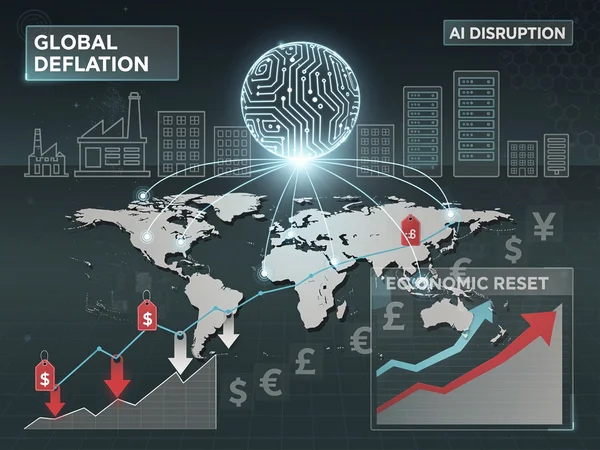
OpenAI chief executive Sam Altman has ignited a fierce debate among economists and technology leaders with his provocative assertion that artificial intelligence will usher in an era of unprecedented deflation, fundamentally challenging decades of monetary policy orthodoxy. His vision of an AI-powered economy where goods and services become exponentially cheaper stands in stark contrast to the inflation-obsessed frameworks that have dominated central banking for generations.
According to Futurism , Altman recently articulated his belief that AI will drive costs down across virtually every sector of the economy, from healthcare to manufacturing, creating what he describes as a deflationary spiral that could reshape global commerce. This perspective arrives at a moment when central banks worldwide remain fixated on combating inflation, potentially preparing for the wrong economic battle entirely.
The OpenAI leader’s thesis rests on the premise that AI systems will dramatically reduce the cost of cognitive labor—the white-collar work that constitutes an increasingly large portion of modern economies. As these systems become more capable, Altman argues, they will compress the expense of everything from legal services to software development, medical diagnostics to financial analysis. The implications extend far beyond mere efficiency gains; they suggest a fundamental restructuring of how value is created and distributed in advanced economies.
Advertisement
article-ad-01The Economic Heresy of Welcoming Deflation
Traditional economic thinking treats deflation as a dangerous pathology to be avoided at nearly any cost. The Federal Reserve and other central banks have spent the past decade desperately trying to generate inflation, fearing the deflationary spirals that characterized the Great Depression. When prices fall, the conventional wisdom holds, consumers delay purchases expecting further declines, businesses cut investment and employment, and economies can enter devastating feedback loops.
Yet Altman’s vision describes a different species of deflation entirely—one driven not by collapsing demand but by exploding productivity. This distinction matters enormously. Historical episodes of deflation have typically occurred during economic contractions when falling prices reflected weakening demand and economic distress. The deflation Altman envisions would emerge from technological abundance, where AI systems produce more value at lower cost, making goods and services genuinely cheaper to create rather than merely reflecting reduced purchasing power.
The closest historical parallel might be the decades-long decline in computing costs, where Moore’s Law delivered exponentially more processing power at lower prices without triggering economic catastrophe. Indeed, the technology sector has experienced persistent deflation in price-per-performance metrics for generations while remaining vibrantly profitable and innovative. Altman essentially argues that AI will extend this dynamic across the broader economy, from manufacturing physical goods to delivering professional services.
Labor Markets Face Unprecedented Transformation
The deflationary mechanism Altman describes operates primarily through labor market disruption. As AI systems become capable of performing cognitive tasks previously requiring human expertise, the cost of that labor—and thus the services it produces—should theoretically decline. A legal brief that once required twenty hours of attorney time at $500 per hour might soon be generated by an AI system for a fraction of the cost. Medical diagnoses, financial analyses, and engineering designs could follow similar trajectories.
This compression of professional service costs could indeed prove deflationary, but the transition period presents profound challenges. Workers whose skills are suddenly devalued may lack the resources or time to retrain for new roles. The economic literature on technological unemployment suggests that while new jobs eventually emerge to replace those destroyed by automation, the adjustment process can be lengthy and painful for displaced workers. The speed at which AI capabilities are advancing may outpace the economy’s ability to absorb and retrain affected workers.
Moreover, the distribution of AI-driven productivity gains remains deeply uncertain. If the benefits accrue primarily to capital owners and a small technical elite, deflationary pressures could coincide with growing inequality and reduced consumer purchasing power among the broader population. This scenario might produce the worst of both worlds: falling prices that reflect weakened demand rather than technological abundance, combined with concentrated wealth that fails to circulate through the economy.
Central Banks Navigate Uncharted Monetary Territory
Altman’s deflationary thesis, if accurate, would require central banks to fundamentally reconsider their policy frameworks. The Federal Reserve’s dual mandate of maximum employment and stable prices assumes that some modest inflation—typically around 2 percent annually—represents a healthy economic state. This target provides a buffer against deflation and allows for real wage adjustments without requiring nominal wage cuts, which workers resist psychologically.
An AI-driven deflationary environment would challenge these assumptions at their foundation. Central banks might need to tolerate or even embrace sustained price declines, distinguishing between destructive deflation driven by weak demand and beneficial deflation driven by productivity improvements. This distinction, however, proves devilishly difficult to implement in practice. Monetary policymakers would need new tools and frameworks to identify which type of deflation they face and respond appropriately.
The risk of policy error looms large. If central banks continue fighting deflation with loose monetary policy in an environment where falling prices reflect genuine productivity gains, they might fuel asset bubbles and financial instability without achieving their objectives. Conversely, if they tighten policy to prevent inflation that AI is already suppressing, they could unnecessarily constrain economic growth and employment. Threading this needle will require wisdom and adaptability that monetary institutions have rarely demonstrated during previous technological transitions.
Corporate Strategy Confronts the Abundance Paradox
For business leaders, Altman’s vision presents a strategic paradox. Companies that successfully deploy AI to reduce costs and improve productivity will gain competitive advantages, potentially capturing market share and improving margins. Yet if all competitors achieve similar efficiency gains, the benefits may flow primarily to consumers through lower prices rather than to shareholders through higher profits. This dynamic already plays out in highly competitive industries where technological improvements quickly become table stakes rather than differentiators.
The strategic imperative, then, may shift from merely deploying AI to finding sustainable competitive moats in an AI-enabled world. Companies might focus on areas where human judgment, creativity, or relationships remain valuable, or on building proprietary data assets and AI systems that competitors cannot easily replicate. Brand value, customer relationships, and regulatory advantages could become even more critical as pure operational efficiency becomes commoditized.
Industry consolidation could accelerate as the fixed costs of developing advanced AI systems favor larger players with more resources and data. Smaller companies might struggle to compete unless they occupy specialized niches where customization and domain expertise provide protection against commoditization. The resulting market structures could paradoxically feature both intense price competition—driving Altman’s deflation—and increasing concentration of market power among a few dominant platforms.
Geopolitical Dimensions of AI-Driven Economics
The deflationary effects Altman describes would not distribute evenly across nations. Countries that successfully develop and deploy AI technologies would capture disproportionate benefits, potentially widening the gap between technological leaders and followers. Nations with strong AI industries might experience productivity-driven deflation while maintaining robust economic growth, even as countries lacking such capabilities face traditional demand-driven deflation or stagflation.
This divergence could reshape global trade patterns and economic relationships. If AI dramatically reduces the cost of manufacturing and services in advanced economies, it might reverse decades of offshoring and globalization. Companies might reshore production as AI and robotics eliminate the labor cost advantages that drove manufacturing to lower-wage countries. Such shifts would have profound implications for developing economies that have relied on labor-intensive manufacturing and service exports as paths to prosperity.
Currency markets would face new pressures as well. Countries experiencing AI-driven productivity gains and deflation might see their currencies appreciate, potentially creating new imbalances and tensions. The dollar’s role as global reserve currency could strengthen if the United States maintains its lead in AI development, or it could face challenges if other nations or blocs develop superior AI capabilities. These dynamics would unfold against the backdrop of existing geopolitical tensions, potentially exacerbating conflicts over technology access and development.
The Social Contract Requires Fundamental Renegotiation
Perhaps most profoundly, Altman’s deflationary vision implies a need to rethink the social contract that has underpinned market economies for centuries. If AI truly delivers radical abundance—making goods and services far cheaper to produce—societies will need new frameworks for distributing that abundance and providing meaning and purpose for citizens whose traditional economic roles have been automated away.
Proposals like universal basic income, which Altman himself has championed through his involvement with various pilot programs, might transition from fringe ideas to necessary policy responses. If deflation makes basic necessities genuinely cheap while AI eliminates many traditional jobs, providing citizens with baseline income could ensure adequate demand to absorb the economy’s productive capacity while preventing social instability. The challenge lies in calibrating such programs to provide security without destroying work incentives or creating fiscal crises.
Education systems would require wholesale transformation as well. If specific skills and knowledge become obsolete more rapidly, the focus might shift from training workers for particular careers to developing adaptability, creativity, and the distinctly human capabilities that AI cannot easily replicate. Lifelong learning would transition from aspiration to necessity, requiring new institutional structures and funding mechanisms to support continuous skill development throughout workers’ lives.
Whether Altman’s deflationary prophecy proves accurate remains uncertain. The path from current AI capabilities to the radical abundance he envisions involves numerous technical, economic, and social hurdles. AI systems might plateau before reaching the transformative capabilities he anticipates, or regulatory and social resistance might slow their deployment. Nevertheless, his thesis deserves serious consideration from policymakers, business leaders, and citizens who will navigate whatever economic transformation AI ultimately delivers. The risk of dismissing his vision as techno-utopian speculation may be smaller than the risk of failing to prepare for the disruptive possibilities it represents.

LEAVE A REPLY
Your email address will not be published