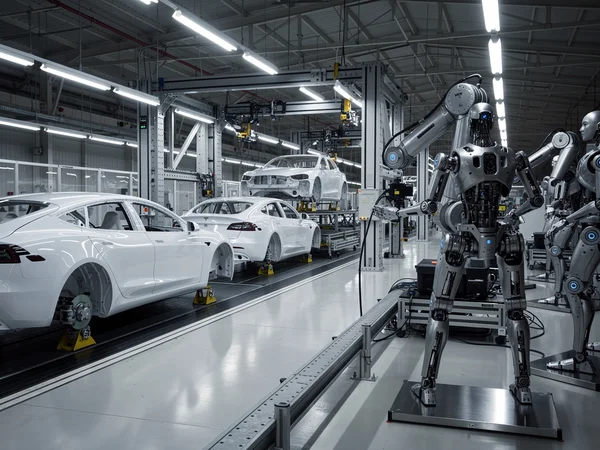
Tesla’s decision to discontinue production of its flagship Model S sedan and Model X SUV marks one of the most dramatic strategic pivots in the company’s history, signaling CEO Elon Musk’s determination to transform the electric vehicle manufacturer into a robotics powerhouse. According to Engadget , the company will cease production of these luxury vehicles to redirect manufacturing capacity toward its Optimus humanoid robot project, a move that has sent shockwaves through both the automotive and technology industries.
The Model S and Model X have served as Tesla’s premium offerings since their respective launches in 2012 and 2015, establishing the company’s reputation for high-performance electric vehicles capable of competing with traditional luxury automakers. Despite their iconic status and loyal customer base, these vehicles have consistently represented a smaller portion of Tesla’s overall sales volume compared to the mass-market Model 3 and Model Y. Industry analysts suggest this production reallocation reflects Musk’s conviction that humanoid robotics represents a far larger market opportunity than premium electric vehicles, potentially worth trillions of dollars according to the company’s own projections.
Advertisement
article-ad-01The Numbers Behind Tesla’s Luxury Vehicle Retreat
Tesla’s luxury segment has experienced declining relevance within the company’s portfolio over recent years. According to Reuters , the Model S and Model X combined accounted for less than 5% of Tesla’s total vehicle deliveries in 2024, with the company delivering approximately 60,000 units of these premium models compared to over 1.7 million Model 3 and Model Y vehicles. This stark disparity in production volumes has made the luxury models increasingly difficult to justify from a manufacturing efficiency standpoint, particularly as Tesla faces growing competition in the premium EV segment from established automakers like Mercedes-Benz, BMW, and newcomers such as Lucid Motors.
The financial implications of this decision extend beyond simple production reallocation. The Wall Street Journal reports that Tesla’s automotive gross margins have compressed significantly over the past two years, falling from approximately 30% in early 2022 to around 18% by late 2024, driven largely by aggressive price cuts aimed at maintaining market share. The Model S and Model X, despite their premium pricing, require dedicated production lines and specialized components that don’t benefit from the economies of scale achieved by the higher-volume models, making them less profitable on a per-unit basis than their price tags might suggest.
Optimus: The Trillion-Dollar Bet on Humanoid Robotics
Tesla’s Optimus humanoid robot project, first unveiled at the company’s AI Day in 2021, has evolved from a concept dismissed by many industry observers as a distraction into what Musk now characterizes as potentially Tesla’s most valuable product. According to CNBC , Musk has stated that Optimus could eventually become “the biggest product ever, of any kind,” with the potential to fundamentally transform the global economy by addressing labor shortages and performing dangerous or repetitive tasks currently handled by human workers.
The technical specifications and capabilities of the latest Optimus prototypes demonstrate significant advancement from the initial demonstrations. TechCrunch reported that the second-generation Optimus robots showcased at Tesla’s Cybercab event in October 2024 displayed improved dexterity, walking speed, and the ability to perform delicate tasks such as sorting objects and even serving drinks to attendees. These demonstrations, while still controlled environments, represent meaningful progress toward Tesla’s stated goal of producing a general-purpose humanoid robot capable of performing a wide range of tasks in real-world settings.
Manufacturing Capacity Reallocation and Production Timeline
The decision to repurpose Model S and Model X production capacity for Optimus manufacturing reflects both the physical requirements of robot assembly and Tesla’s confidence in near-term commercialization. Sources familiar with Tesla’s manufacturing operations, speaking to Bloomberg , indicate that the company plans to convert portions of its Fremont, California factory previously dedicated to luxury vehicle production into specialized assembly lines for humanoid robots. This conversion is expected to begin in the second quarter of 2025, with initial production targets of several thousand Optimus units by year-end.
Tesla’s manufacturing expertise in high-volume production and vertical integration positions the company uniquely for robotics manufacturing. Unlike traditional robotics companies that often rely on third-party suppliers for critical components, Tesla manufactures many of its own actuators, sensors, and computing systems in-house. The Verge notes that this vertical integration approach, combined with the company’s experience in automotive manufacturing at scale, could provide significant cost advantages in producing humanoid robots compared to competitors like Boston Dynamics or Figure AI, which lack similar manufacturing infrastructure.
Market Reaction and Competitive Implications
The announcement has generated mixed reactions from investors and industry analysts, with Tesla’s stock experiencing volatility following the news. MarketWatch reported an initial 3.2% decline in Tesla shares as some investors expressed concern about abandoning proven revenue streams for unproven robotics products. However, long-term Tesla bulls have rallied behind the decision, arguing that the company’s future growth potential lies in artificial intelligence and robotics rather than incremental improvements to its automotive lineup.
The competitive dynamics in the luxury EV segment have shifted dramatically since Tesla’s Model S first disrupted the market over a decade ago. Automotive News reports that traditional luxury automakers have collectively invested over $300 billion in electric vehicle development, with models like the Mercedes EQS, BMW iX, and Porsche Taycan now offering comparable or superior performance, range, and luxury features to Tesla’s aging flagship models. The Model S, despite periodic updates, maintains a basic design architecture dating back to 2012, making it increasingly difficult to justify its premium pricing against newer competitors with more advanced technology and refined interiors.
The Broader Robotics Industry Context
Tesla’s aggressive push into humanoid robotics occurs amid growing interest and investment across the technology sector in general-purpose robots. Forbes reports that venture capital funding for humanoid robotics companies exceeded $2.5 billion in 2024, more than triple the investment level from 2023, as companies and investors recognize the potential for robots to address labor shortages in manufacturing, logistics, healthcare, and service industries. This surge in interest has attracted major technology companies including Microsoft, Nvidia, and Amazon, all of which have announced significant investments or partnerships in humanoid robotics development.
The technical challenges facing humanoid robotics remain substantial, despite recent progress. IEEE Spectrum identifies several critical obstacles including power density limitations in batteries, the complexity of bipedal locomotion in unstructured environments, and the enormous computational requirements for real-time decision-making and manipulation tasks. Tesla’s advantage in battery technology and neural network training infrastructure may help address some of these challenges, but the company will need to demonstrate that Optimus can perform economically valuable tasks reliably enough to justify its development costs and production investment.
Economic Implications and Labor Market Concerns
The economic implications of successful humanoid robot deployment extend far beyond Tesla’s business prospects, potentially reshaping labor markets and industrial production globally. The Economist estimates that if humanoid robots achieve even modest penetration in manufacturing and logistics sectors, they could displace between 20-30 million jobs globally by 2035, while simultaneously creating new categories of employment in robot maintenance, programming, and supervision. This dual impact presents both opportunities and challenges for policymakers grappling with automation’s effects on employment and income distribution.
Musk has stated that Tesla aims to price Optimus robots at approximately $20,000-$30,000 per unit at scale, positioning them as cost-competitive with human labor in many applications. Financial Times analysis suggests that at this price point, with an assumed operational lifespan of 5-7 years, Optimus robots could achieve payback periods of less than two years in applications like warehouse operations or manufacturing assembly, making them economically attractive to businesses facing persistent labor shortages and rising wage costs. However, achieving this target price will require Tesla to reach production volumes in the hundreds of thousands of units annually, a milestone that remains years away even under optimistic scenarios.
Customer Impact and Brand Evolution
For Tesla’s existing Model S and Model X customers, the discontinuation raises questions about long-term support, parts availability, and resale values. InsideEVs reports that Tesla has committed to continuing service and parts support for existing vehicles for at least ten years, consistent with industry standards, though some owners express concern about the company’s attention to aging models as it shifts focus to robotics. The decision also eliminates Tesla’s presence in the luxury sedan and SUV segments, potentially directing high-end customers toward competitors or the company’s more mainstream Model 3 and Model Y offerings.
This strategic pivot represents a broader evolution of Tesla’s brand identity from a pure automotive company to a diversified technology and artificial intelligence enterprise. Business Insider notes that Tesla’s market valuation has increasingly reflected investor expectations about its potential in autonomous driving, energy storage, and now robotics, rather than traditional automotive metrics. The company’s price-to-earnings ratio of over 60 significantly exceeds traditional automakers, indicating that investors are pricing in substantial growth from non-automotive businesses. Whether this valuation proves justified depends largely on Tesla’s ability to commercialize Optimus successfully and capture meaningful market share in what remains a nascent and unproven industry.

LEAVE A REPLY
Your email address will not be published