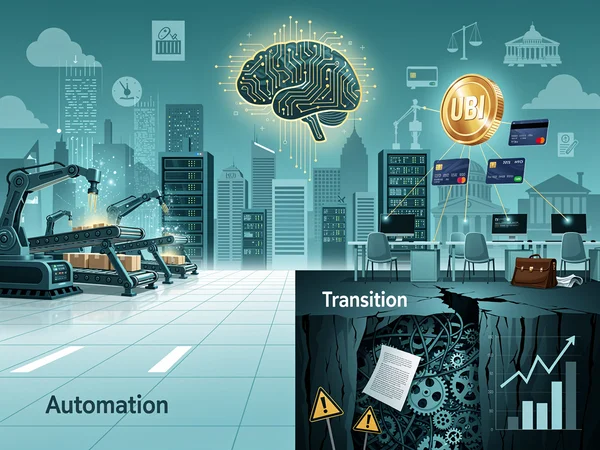
The technology sector’s most powerful voices have long promoted a seductive narrative: as artificial intelligence displaces human workers across industries, universal basic income will serve as society’s safety net, transforming economic disruption into shared prosperity. Yet this vision, championed by figures from Sam Altman to Elon Musk, rests on assumptions about human nature, economic systems, and political will that may prove dangerously optimistic.
According to Futurism , the relationship between AI-driven automation and universal basic income has emerged as one of the defining policy debates of our era. The premise appears straightforward: as machines assume jobs previously performed by humans, governments would distribute regular cash payments to all citizens, funded by taxes on the productivity gains generated by AI systems. This framework promises to address technological unemployment while maintaining consumer purchasing power essential for economic stability.
However, the mechanics of this transition reveal complexities that challenge the Silicon Valley consensus. The assumption that displaced workers will simply accept monthly stipends while machines generate wealth ignores fundamental questions about human dignity, social cohesion, and the political economy of redistribution. More troubling still, it presumes that societies will successfully navigate the treacherous period between widespread job displacement and the implementation of functional income support systems—a transition that could span years or decades.
Advertisement
article-ad-01The Flawed Economics of Automated Abundance
The universal basic income proposition relies on a critical assumption: that AI-driven productivity gains will generate sufficient wealth to fund meaningful payments to entire populations. Yet economic history suggests that technological revolutions rarely distribute their benefits evenly or automatically. The past four decades of computerization have coincided with stagnant median wages, declining labor share of income, and widening inequality across developed economies.
Contemporary AI systems are already demonstrating this pattern. While companies deploying machine learning and automation report significant efficiency improvements, these gains have primarily accrued to shareholders and highly-skilled workers who complement rather than compete with AI. The notion that democratic societies will successfully tax these concentrated gains and redistribute them broadly assumes a level of political consensus that appears increasingly elusive in an era of polarization and institutional gridlock.
The Political Economy of Displacement
Perhaps more fundamentally, the UBI-as-solution framework underestimates the political backlash that mass technological unemployment would likely trigger. Workers displaced by automation would not patiently wait for policymakers to design and implement income support systems. Instead, history suggests they would mobilize politically to restrict or slow automation itself—demanding regulatory barriers, imposing taxes that make human labor competitive, or supporting politicians who promise to preserve existing jobs regardless of efficiency considerations.
This political dynamic creates a paradox at the heart of the AI-UBI vision. The very productivity gains that would theoretically fund universal income depend on allowing widespread automation to proceed. Yet the social disruption created by that automation would likely generate political movements demanding its restriction. Democratic societies may prove unwilling to endure the transition costs, even if promised eventual benefits. The Luddites, after all, were not simply mistaken about technology’s long-term potential—they were rational actors responding to the immediate devastation of their livelihoods.
Beyond Cash: The Meaning Crisis
Even if societies successfully implement universal basic income systems, a deeper challenge remains largely unaddressed in techno-optimist visions: the psychological and social functions that work provides beyond income. Employment structures daily life, provides social identity, creates community connections, and offers individuals a sense of purpose and contribution. The assumption that cash payments can substitute for these intangible benefits reflects a reductive view of human flourishing.
Research in psychology and sociology consistently demonstrates that long-term unemployment correlates with depression, substance abuse, family breakdown, and premature mortality—even when basic material needs are met. These outcomes persist across cultures and economic systems, suggesting they reflect something fundamental about human nature rather than merely the stigma attached to joblessness in particular societies. A world where most people receive income without working may face a crisis of meaning that no amount of financial support can address.
The Infrastructure Gap
The practical challenges of implementing universal basic income at scale receive insufficient attention in many technology-sector discussions. Existing welfare systems in developed countries struggle with complexity, administrative burden, and political sustainability despite serving only portions of their populations. Expanding such systems to provide meaningful income to all citizens would require governmental capacity that many nations lack.
Determining appropriate payment levels presents particularly thorny questions. Set too low, UBI fails to provide genuine economic security, defeating its purpose as a response to technological unemployment. Set too high, it risks creating unsustainable fiscal burdens, inflationary pressures, or work disincentives that undermine economic productivity. The political process of establishing and adjusting these levels would likely prove contentious, with different constituencies advocating for incompatible priorities.
Alternative Futures Beyond the Binary
The framing of AI’s labor impact as a binary choice between mass unemployment and universal basic income may itself represent a failure of imagination. Historical technological transitions have typically created new categories of work alongside displacing old ones, though often after painful adjustment periods. The question is not whether AI will eliminate all jobs, but rather which jobs disappear, which emerge, and how societies manage the transition.
Some economists argue for focusing policy attention on education and training systems that help workers adapt to changing labor markets, rather than accepting mass unemployment as inevitable. Others advocate for reducing working hours across the economy, distributing available work more broadly while maintaining employment’s social benefits. Still others suggest that human labor may remain economically valuable in domains requiring creativity, emotional intelligence, or physical dexterity that prove difficult to automate—though these domains may differ significantly from today’s employment patterns.
The Timing Problem
Perhaps the most critical flaw in the AI-UBI narrative is its assumption of synchronized timing. The scenario requires that societies implement universal income systems before technological unemployment creates widespread social crisis, yet after AI capabilities advance sufficiently to generate the productivity gains funding such systems. This narrow window may prove difficult or impossible to navigate in practice.
Current AI systems demonstrate impressive capabilities in specific domains while remaining far from the general intelligence that would enable wholesale automation across industries. This creates a prolonged period of partial disruption—enough to displace significant numbers of workers in particular sectors, but insufficient to generate the economic transformation that might justify and fund comprehensive income support. Societies may face the worst of both worlds: substantial unemployment without the compensating productivity gains that techno-optimists envision.
Global Dimensions of Disruption
The geographic distribution of AI’s impacts adds further complexity to universal basic income proposals. Developing nations, where most of humanity resides, lack the fiscal capacity to implement meaningful UBI systems even as their workers face displacement from automation. The garment workers in Bangladesh, call center employees in the Philippines, and manufacturing laborers across Southeast Asia cannot rely on their governments to provide income support comparable to what might be feasible in wealthy nations.
This creates potential for unprecedented global inequality, as AI-driven productivity accrues primarily to developed economies and their corporations while unemployment spreads worldwide. The resulting migration pressures, political instability, and international tensions could reshape geopolitics in ways that current discussions of universal basic income largely ignore. The assumption that AI’s benefits will somehow trickle down globally appears particularly naive given historical patterns of technological change.
Rethinking the Social Contract
Ultimately, the debate over AI and universal basic income reflects deeper questions about the social contract in an age of technological transformation. The current system links income to work, which in turn provides not just material support but social status, personal identity, and political standing. Severing this connection through UBI would represent a fundamental reimagining of how societies organize themselves—a change far more profound than simply modifying tax and transfer systems.
Whether democratic societies can successfully navigate this transition remains an open question. The techno-optimist vision assumes a level of rational planning, political consensus, and institutional capacity that may prove unrealistic. Yet the alternative—allowing technological change to proceed without adequate social support systems—risks instability that could derail the very innovation that proponents celebrate. The challenge facing policymakers is not simply designing better income support programs, but rather managing a transformation in the relationship between technology, work, and human flourishing that will define the coming century. The stakes could not be higher, and the margin for error appears distressingly narrow.

LEAVE A REPLY
Your email address will not be published