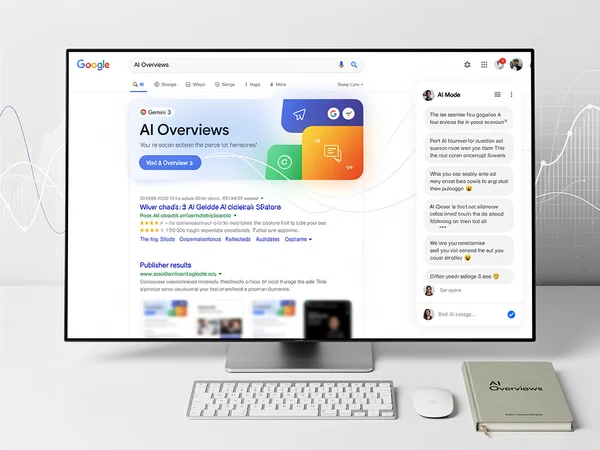
Google has elevated its search engine into a conversational powerhouse by installing Gemini 3 as the default engine for AI Overviews worldwide and enabling direct follow-up questions that flow into AI Mode. Announced on January 27, 2026, these changes mark a pivotal evolution in how billions interact with information, prioritizing fluid AI dialogues over traditional link lists.
Robby Stein, vice president of product for Google Search, described the shift as delivering ‘a quick snapshot when you need it, and deeper conversation when you want it.’ Users now type follow-ups straight from an AI Overview summary, preserving context as the interface seamlessly transitions to AI Mode on mobile devices globally. This builds on tests that began in December 2025, where Google observed preferences for natural conversational flows.
The upgrade responds to user demands for handling complex queries without rigid keywords, mimicking chatbot experiences like ChatGPT but grounded in real-time web data. Gemini 3, launched in November 2025, brings superior reasoning to grasp nuance and intent, outperforming rivals on benchmarks for math, science, and multilingual tasks, according to Google’s announcements.
Advertisement
article-ad-01Gemini 3 Powers Precision Responses
In its official blog, Google stated, ‘Gemini 3 is now the default model for AI Overviews, giving you better AI responses.’ Previously limited to subscribers or specific queries, the model now delivers ‘best-in-class AI response right on the search results page’ for relevant questions across all users. This expands from its initial day-one integration into AI Mode, where it introduced dynamic visual layouts like interactive tools and simulations.
Search Engine Journal reported that the rollout makes Gemini 3 the standard in markets where AI Overviews operate, with automatic routing for tough questions to frontier capabilities while faster models handle simpler ones. Engadget noted that this should yield ‘more credible and relevant summaries,’ addressing past criticisms of AI-generated inaccuracies.
TechCrunch highlighted the preserved context in transitions: ‘The experience is designed to feel like a single flow, with links enabling movement from a quick snapshot to a deeper conversation.’ CNET emphasized the agentic nature, where AI ‘handles query work’ in natural language, shifting from keyword precision.
Seamless Bridge to AI Mode Conversations
From an AI Overview, users scroll and type to enter AI Mode, overlaying the chat interface while hiding sources temporarily—an X in the corner returns to results, per Search Engine Land. This direct path, tested globally on mobile last December, fulfills Stein’s vision: ‘Our vision for Search is to make it effortless to explore, access and understand information.’
The Verge framed it as Google making ‘Search less about links and more about AI,’ with Stein adding that Overview answers will be ‘best-in-class.’ On X, Stein posted updates like ‘AI Overviews now tap into Gemini 3 Pro for complex topics,’ signaling ongoing refinements with intelligent model selection live in English for premium subscribers.
Google’s testing revealed users favor this integration, as ‘asking follow-up questions while keeping the context from AI Overviews makes Search more helpful.’ AI Mode, launched to U.S. users in May 2025 and globally in August, now merges more tightly with Overviews, which boast 2 billion monthly users.
Industry Ripples and Publisher Pressures
Publishers face mounting challenges as AI keeps users within Google’s ecosystem longer. Search Engine Land warned, ‘This update will result in less traffic to sites and more traffic to Google’s AI Mode,’ with citation cards harder to click amid pushes to conversations. CNET echoed, ‘More AI in Search is likely bad news for publishers, who have already felt the adverse effects of AI Overviews.’
Yet Google underscores benefits like personalized intelligence, pulling from Gmail and Photos for tailored responses. Stein teased on X in December 2025: ‘Today we’re starting to test a new way to seamlessly go deeper in AI Mode directly from the Search results page on mobile, globally.’
9to5Google detailed the mechanics: tapping ‘Show more’ overlays AI Mode with an ‘Ask anything’ bar, no need to navigate tabs. This aligns with Gemini 3’s PhD-level reasoning, scoring high on GPQA Diamond (90.4%) and MMMU Pro (81.2%) benchmarks for technical and multimodal queries.
From Launch to Global Dominance
Gemini 3’s journey began with hype in November 2025, topping LMArena and integrating into Search on release day for AI Mode. Variants like Gemini 3 Flash rolled out globally in December for speed, while Pro handled depth. By January 2026, it powered Overviews universally, with X discussions from @GoogleAI recapping integrations via podcasts with Stein.
On X, users like @JulianGoldieSEO noted interactive outputs: ‘Instead of reading 10 articles, you get interactive diagrams, custom calculators, visual modules.’ Google posted demos of Gemini 3 visualizing physics queries with real-time simulations.
Competitors loom—OpenAI’s GPT updates and Anthropic’s Claude—but Google’s scale prevails, with AI Overviews at 2 billion users monthly and Gemini app at 650 million. Stein affirmed on X: ‘This brings us closer to our vision for Search: just ask whatever’s on your mind—no matter how long or complex—and find exactly what you…’
Technical Edge and Future Horizons
Gemini 3 excels in agentic workflows, as @philschmid highlighted open-source examples for multi-agent suites and web automation. Search Engine Land contrasted prior subscriber-only Pro access with today’s broad default. The 1 million token context aids long tasks, reducing hallucinations via real-time grounding.
Privacy features like Temporary Chat address concerns amid Gmail integrations, where AI Overviews summarize threads for all users. Rollouts prioritize mobile, with desktop expansions implied. As Stein posted, separate quotas for Thinking and Pro models enhance flexibility: AI Pro gets 300+100 prompts daily.

LEAVE A REPLY
Your email address will not be published