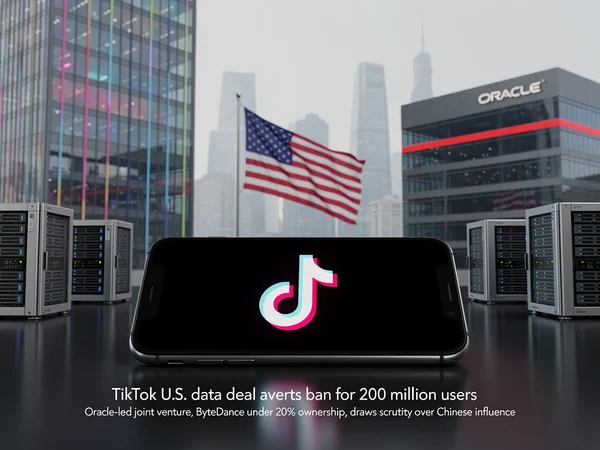
After years of threats, lawsuits and political maneuvering, TikTok has finalized a complex joint venture that allows its U.S. operations to continue amid national security fears tied to its Chinese parent, ByteDance. The agreement, announced Thursday, creates a new American entity majority-owned by U.S.-aligned investors, with Oracle Corp. taking charge of data storage and algorithm training for the app’s 200 million American users. This move complies with a 2024 federal law mandating divestiture or a ban, following extensions granted by President Trump during his second term.
The deal’s architects include Oracle, private-equity firm Silver Lake and Abu Dhabi-based MGX, each holding 15% stakes, while ByteDance retains less than 20%. Existing TikTok investors control about 30%, with notable backers like Revolution—once led by Vice President JD Vance—and Michael Dell’s family office. TikTok CEO Shou Zi Chew hailed the structure in an employee memo, calling it a “majority American owned joint venture” with “defined safeguards that protect national security through comprehensive data protections, algorithm security, content moderation and software assurances for U.S. users.” ( Wall Street Journal )
Advertisement
article-ad-01President Trump celebrated the outcome on social media, posting, “I am so happy to have helped in saving TikTok!” He credited Chinese President Xi Jinping for approving the deal, adding, “He could have gone the other way, but didn’t, and is appreciated for his decision.” The arrangement ends a saga that began in Trump’s first term with ban attempts, evolved through Biden-era legislation and culminated in this Trump-brokered compromise.
The Venture’s Ownership Puzzle
Details on ownership remain a flashpoint. Posts on X from industry watcher Chris McGuire highlighted ByteDance’s 19.9% slice as the largest single holding, with Silver Lake, Oracle and MGX at 15% each, and the rest scattered among other investors at 35.1%. “So after years of negotiating a divestiture deal, the largest investor in the new U.S. TikTok is…ByteDance,” McGuire noted, questioning its security implications. ( X post by Chris McGuire )
Adam Presser, Chew’s deputy, will helm the new entity, backed by a board featuring Chew, Oracle’s Ken Glueck and investor representatives. The setup values the venture at roughly $14 billion, per Vance’s prior comments, with investors ponying up a multibillion-dollar fee to the U.S. government—echoing Trump’s “tremendous fee-plus” rhetoric. Yet skeptics, including This American Adam on X, flagged opacity around ByteDance-linked apps bundled into the U.S. entity, listing over a dozen titles like CapCut and Lemon8 previously restricted by Apple.
Vance’s ties add intrigue: His brief tenure at Revolution, founded by AOL co-founder Steve Case, preceded his Senate run. The firm’s involvement underscores how venture networks intertwined with Trump’s orbit shaped the outcome. ( X post by This American Adam )
National Security Safeguards Under Scrutiny
Oracle’s role is pivotal: The cloud giant, already handling TikTok’s U.S. data since 2020, now oversees algorithm training to block Chinese influence. This builds on prior arrangements but formalizes them under the new entity. The New York Times reported the deal loosens ties to China, creating an “American TikTok” via non-Chinese investors. ( New York Times )
Reuters confirmed the joint venture secures U.S. data for over 200 million users—up from 170 million cited in 2024—averting a ban. “TikTok’s Chinese owner, ByteDance, on Thursday said it has finalized a deal to establish a majority American-owned joint venture,” the wire service wrote. Approval from both U.S. and Chinese regulators was key, navigating Beijing’s tech export controls. ( Reuters )
Critics persist. Lawmakers and security advocates worry ByteDance’s stake enables influence, despite firewalls. The Guardian noted the venture includes Larry Ellison’s Oracle, Silver Lake and MGX, sidestepping the ban but not erasing all doubts. ( The Guardian )
Trump’s TikTok Pivot
Trump’s embrace marks a reversal from his 2020 ban push. He delayed the 2024 law’s enforcement via executive orders, buying time for negotiations. On Thursday, he boasted of TikTok’s boost to his reelection, claiming higher engagement than Meta’s Instagram. “TikTok helped me win my second term,” he posted on Truth Social.
The Associated Press detailed the investor lineup, emphasizing U.S. control. NPR covered the Oracle-led group’s aim to resolve the standoff over ByteDance’s ties. Axios broke early sale talks in December 2025, framing it as ending yearslong uncertainty. ( Associated Press ; NPR ; Axios )
BBC reported the split of U.S. operations from global business, with Trump threatening a ban absent divestiture. Fox Business cited a White House official on the U.S.-China agreement for the spin-off. ( BBC ; Fox Business )
Investor Web and Valuation Nuances
Interconnected backers amplify U.S. sway. Ellison’s Oracle shares Trump affinities, while Silver Lake and MGX bring deep pockets. India Today noted clearance by both governments, protecting user data. The New York Times profiled investors’ Trump links in a follow-up. ( India Today ; New York Times )
Dylan Byers on X linked to the Times announcement, signaling the legal saga’s close. This American Adam questioned compliance with divestiture law as a January deadline loomed. ( X post by Dylan Byers ; X post by This American Adam )
The fee to Washington underscores the deal’s novelty, potentially funding security enhancements. User growth to 200 million reflects TikTok’s resilience despite headwinds.
Operational and Regulatory Road Ahead
Implementation demands scrutiny: Data migration to Oracle, algorithm audits and board oversight will test safeguards. Chew’s leadership continuity, via Presser, ensures operational stability. Lawmakers may probe further, as X discussions from McGuire suggest.
The venture’s success hinges on enforcing separations from ByteDance’s global arm, amid U.S.-China tech frictions. For industry insiders, this sets precedents for foreign apps, blending commerce, security and politics in equal measure.

LEAVE A REPLY
Your email address will not be published